
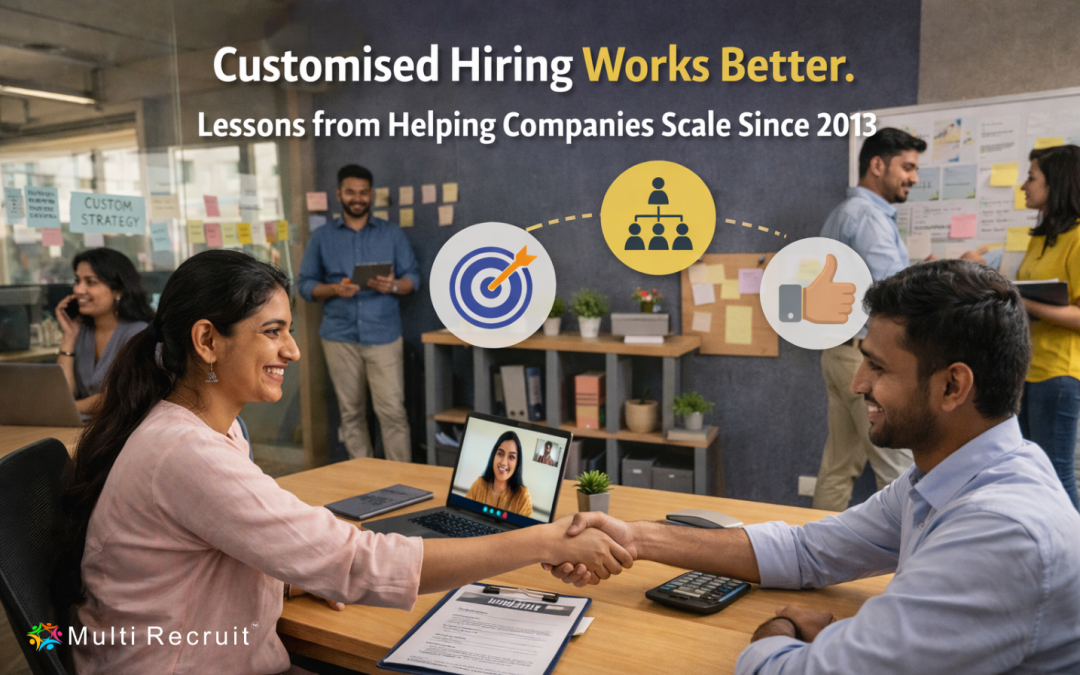
Since 2013, Multi Recruit has worked with startups, growing businesses, and global organisations to build teams in India across sectors such as IT, BFSI, E-Commerce, and the outsourcing and offshoring industry. The journey did not begin with a single breakthrough idea. It began with a series of practical observations about what was failing in traditional recruitment and what companies genuinely needed as they scaled.
One lesson has remained consistent through every phase of growth, market cycle, and hiring trend: customised hiring delivers stronger results than standardised models. When hiring plans reflect business realities, team maturity, and long-term intent, outcomes improve across quality, retention, and speed.
This article shares founder-led insights shaped by more than two decades of hands-on experience supporting startups, SMBs, and GCC recruitment initiatives in India.
Why Standard Hiring Models Fall Short as Companies Grow
Early in Multi Recruit’s journey, a fixed-cost hiring model was tested. On paper, it appeared efficient and predictable. In practice, it struggled to deliver consistent outcomes. Roles varied widely, timelines shifted, and business priorities changed faster than predefined packages could adapt.
What became clear was simple. Hiring problems rarely stem from a lack of spending. They stem from misalignment between role needs, candidate expectations, and execution models.
Startups hiring their first 10 engineers face challenges very different from SMBs expanding into new markets. Micro GCCs building teams of 20 to 150 people operate under entirely different pressures than large enterprises hiring at scale. Applying the same approach to all of them leads to friction, missed hires, and attrition, especially in competitive domains like web development, mobile development, full-stack development, and Cloud Architect roles.
Lessons from the Startup Hiring Wave
In the early 2010s, India’s startup ecosystem was accelerating rapidly. Speed mattered. Skills dominated hiring conversations. Cultural alignment received limited attention simply because teams were racing against time and funding milestones.
As founders observed, many companies hired fast but paid the price later. Mismatches surfaced after onboarding, and teams struggled to stay aligned while attrition quietly eroded momentum.
This period highlighted a core truth: hiring for immediate capability without understanding candidate motivation creates instability. Effective talent acquisition solutions require clarity on why a role exists, how it contributes, and what kind of individual will succeed within that environment.
Customised hiring frameworks emerged naturally from this learning, where each role required context, not just keywords. This applied strongly to early hires in mobile development, product engineering, and data-focused roles such as Data Scientist.
From Skills to Stories: How Hiring Expectations Evolved
By the mid-2020s, the Indian hiring market looked very different. Startups matured, GCCs expanded, and opportunities multiplied for skilled professionals across healthcare, retail, media & communication, and real estate sectors.
Technology began handling repetitive recruitment tasks. AI improved screening efficiency and validation accuracy. Structured tools such as video interviewing helped standardise early-stage evaluations. Yet one insight stood firm: technology supports hiring, but it cannot replace human understanding.
Founders at Multi Recruit began pushing teams and clients to look beyond resumes:
- What motivates the candidate?
- What work environment helps them perform?
- What kind of growth do they expect?
When hiring aligns personal purpose with organisational direction, engagement improves. This perspective reshaped how recruitment services were designed, placing equal weight on capability, context, and intent.
Customisation as a Response to Business Risk
As Multi Recruit scaled internally from a five-member team to over fifty professionals, leadership gained first-hand exposure to the risks of poor hiring design. Every exit had consequences beyond replacing headcount.
For growing teams, attrition is not a reporting metric. It affects delivery timelines, product continuity, and internal trust. This lesson became even more relevant when supporting global firms setting up micro GCCs in India through structured GCC recruitment programs.
Many organisations initially focused on cost optimisation, but conversations often shifted toward role clarity, stability, and workforce design. Short-term, contract-heavy setups struggled to maintain continuity, while teams built through customised hiring approaches showed stronger retention than those relying purely on contract staffing.
Designing Hiring Around Scale Stages
Customised hiring works because it adapts to where a company stands today and where it intends to go next.
For early-stage startups, priorities often include speed, adaptability, and cross-functional talent. For SMBs, hiring shifts toward greater process consistency and deeper leadership. For GCCs, the emphasis moves to knowledge retention, IP continuity, and long-term commitment.
A one-size framework cannot address all these needs. A thoughtful recruitment strategy must assess:
- Business maturity
- Team size and structure
- Growth roadmap
- Risk tolerance
- Market competition
This diagnostic approach allows end-to-end recruitment solutions to remain flexible while staying outcome-focused.
Why Customised Hiring Improves Retention
Retention improves when hiring decisions consider future alignment rather than short-term wins. When candidates understand role expectations clearly and see growth paths early, commitment strengthens.
Customised corporate recruitment services factor in not just role delivery but team dynamics, leadership style, and cultural expectations. This reduces mismatches that typically surface months after joining and supports stable growth in sectors such as IT, BFSI, and global service operations.
The Role of Partnership in Recruitment Success
Another defining lesson since 2013 has been the value of partnership. Recruitment works best when providers operate as advisors rather than vendors.
Multi Recruit’s founders built the organisation around collaboration, challenging assumptions, refining role definitions, and aligning hiring strategies with business outcomes. This approach reshaped how recruitment services in India could support both domestic and global employers.
Where Customised Hiring Is Heading Next
Hiring will continue to evolve alongside technology, global workforce models, and candidate expectations. Automation will improve efficiency, but decision quality will still depend on human insight.
Customised hiring remains relevant because businesses themselves are not uniform. Each company’s growth story is different, and each team’s needs are specific.
The founders’ experience since 2013 confirms one thing: scalable hiring is built through intention, not templates. The organisations that invest time in design today reduce risk tomorrow.
Build a Hiring Model Designed for Your Growth
Whether you are a startup building early teams, an SMB expanding operations, or a global organisation setting up teams in India, hiring design matters.
Multi Recruit offers tailored recruitment solutions aligned with your business stage, goals, and long-term vision. As an experienced hiring partner, we support organisations through GCC recruitment, contract staffing, and structured video interviewing solutions.
Explore how our end-to-end recruitment solutions can support your growth journey.
https://www.multirecruit.com/employer/recruitment-solution/